Sunday, August 27, 2023

Book Review: The Creative Lives of Animals


Image: The Cover of the book is a photo of 7 red- throated bee eaters - birds with green and orange bodies,  fanned out tails, long thin black beaks, a black mask line, and red throats- together on a clay wall with several nesting cavities. Weaving in and out of the birds is the title in large white letters. Across the bottom in yellow letters is the authors name: Carol Gigliotti.

I enjoyed reading Carol Gigliotti's The Creative Live of Animals for VINE book club this month. I wanted to wait until after hearing from the author, who kindly joined us, to write this review. Hearing more from her changed some of the ways I thought about this book. 

I love when people reach across fields to write about topics. It can be a mess when done poorly, but when done well, it offers a set of fresh eyes and a different voice- in this case, on animals' ways of experiencing and interacting with the greater world. Gigliotti comes to us as an artist who explores the inner and outer worlds of other animals through the lens of creativity. I believe that this is mostly done well and can create a bridge for people to experience these topics who may not seek out a more academic book. It is not that this is not an academic work. I am struggling to find the words to differentiate this work from the jargony type of text written primarily for others in one's field.

I admit that while reading this book, I found a lot of information from animal intelligence, emotion, language, sexuality, culture, etc that I had already read (though many species-specific things that I had not.) I was struggling to find what made this book stand out specifically as being about creativity itself. Each chapter is full of interesting research, well conveyed, but the descriptions of how creativity fit into the equation were too short for my taste. However, one of the things I liked about this author was the approach of acknowledging how anthropocentric definitions of various terms- including creativity and all others in this paragraph- limit us in understanding what creativity really means for other species. Looking at it that way, I could see her point that things like "intelligence" and other attributes have great overlap with creativity. The various things she chose to combine in this book also make it stand out from others in similar fields.

In terms of studies discussed, I really loved the section on prairie dog language and culture. I know I had read something about this elsewhere, but barely remembered it and it was a joy to read all of the research about these complex communication systems. I also enjoyed learning about the Moscow stray dogs who learned to use the subway systems. As a birder, my most favorite sections were on the languages and creativity of brown thrashers and gray catbirds. I've had the pleasure of listening to and watching the serenades of brown thrashers and catbirds, but had no idea how complex these songs were until this book. We often learn of these birds as "mimics" because they incorporate songs of other birds (and animals, car alarms, etc.) Would we call a composer a mimic for using notes and instruments created by others before them? These were the places I could see very clearly how "creativity" as I understand it came into play. That is not to say bird song is the same as human music- it is far more other-worldly than that in ways we will never be able to truly understand, which is part of why it is so lovely to witness. Field guides will say a species sings to "defend territory" or "attract a mate" which is in part true, but only a small part of the equation. After all, the colonizers running around shooting birds to draw them before returning home to their enslaved house mates (*cough* Audubon *cough*) used to think only male birds sang, which we now know is completely false, as is the notion that there are singular reasons why birds sing and communicate. A book written by an ornithologist might gloss over the creativity aspect which is one of many ways this book shines.

One of the best things about how research was discussed in this book was how the author never shied away from ethics. I complain frequently of how even the most animal liberation minded authors will sometimes include information from gnarly animal studies without comment, I suppose to be more accessible to the fragile colleagues who can't bear to think of a world without animals suffering in laboratory cages. Gigliotti manages to share results while adding something I have not seen said quite the way she did. She not only comments about the ethical issues with the research, but that the research itself hides results from us. Mainly, what would this creativity (or intelligence, etc) that we are studying look like if it were not forced by human hands and defined solely by us?

While listening to the author in book club, I appreciated the discussion of the creativity metric being used as a bridge to bring this information to a wider audience. People put off by words like "agency" might be more willing to read about "creativity." That made me more comfortable with some of my early confusion about what was creativity and what was not. She also shared an anecdote about another author saying something about how the greater than human world is inextricably linked with human creativity. I tried imagining the history of all creativity mediums if other animals were never present and I realized just how intricately they are woven throughout human creative mediums (in some good and not so good ways.) 

All in all, I think this book adds something useful to the shelf of animal studies. I would have liked a tighter grasp and focus on creativity as it branches further away from things like intelligence, but I still learned a lot and, more importantly, learned new ways to think about the lives of myself and other animals. I would love to read a full book by the author on creativity of birds specifically in the future.

This was also posted to my goodreads.

Monday, August 14, 2023

Book Review: Open Throat


Image: cover of the book is an ivory background with a stencil like image of the face of a mountain lion. The stencil is all black except for the eyes which are shades of pink orange and yellow. Across the top is the title open throat written and streaks like a marker made up of black, pink, Orange, and yellow. Along the bottom is the author's name Henry hoke in the same style. And small letters along the left side are the words "a novel."

This will be a short review for a short little book. I wasn't sure exactly what to expect from Henry Hoke's novel Open Throat. I have had a range of experiences with anthropomorphized accounts of other animals. Let me be clear, when I say anthropomorphized,  I'm not saying that acknowledging that other animals have feelings and inner thoughts is anthropomorphism. I mean a lion speaking a human language in a fantasy-like book form to be read easily by us is. 

Anyway, reading the description about a queer mountain lion romping through California made me think I would be humorously entertained. I did not expect to be brought to tears. I don't know if everyone would have that reaction, but as someone who has dealt with a lot of animal rescue and also tries to create a bridge between humans and other animals to better understand one another, I felt that this author captured something quite real in the way that they wrote about the mountain lion and his life. This mountain lion is no doubt a wild being, but like many animals with lots of interactions with humans such as hikers and campers, there is a level of domestication that happens. There are tons of things in this book that are completely outlandish, but the feelings and thought processes are there, described in ways that humans can digest.

The two particular points in the book- a section about a highway and the ending- were the most emotional for me. I hope that people come into this book looking for entertainment and come out thinking a lot more about what may be going through the minds of other animals that we see as nuisances, pests, dangerous, or any other number of one-dimensional, anthropocentric descriptions. 

This book was a surreal experience of many all too real things.

This was also posted to my goodreads.

Book Review: Practicing New Worlds

Image: The cover of the book is a color block illustration of a landscape with reddish brown mountains in the distance and a river of shades of blue cascading down toward the bottom. The river turns into a pathway going up the mountains. It is bordered by yellow mushrooms and turquoise leaves and vines.  In the foreground, the strands of the river are held by two feminine people with their backs to the viewer. One has medium brown skin and long dark hair and the other has darker brown skin with black curly hair. Both have yellow earrings and clothing and a purple butterfly in their hair and on their shoulder. Moving up the path are many figures with a variety of skin tones all clad in light turquoise walking or rolling (via wheelchair or walker) up into the mountains. The sky is a dark blue with speckled stars and a large moon obscured by the mountains.

The non-fiction entries of the emergent strategy series have been a real mixed bag for me. Strangely enough, many entries by the creator herself have left me unsatisfied. For that reason, I'm very glad that she has communicated with so many other contributors to the series, including Andrea J. Ritchie. I'm a big fan of Ritchie's work, so when I saw that Practicing New Worlds was coming out, I was excited to see what her contribution would look like. In the intro, adrienne marie brown mentions thinking she and Ritchie were both part of the same struggle but in very different ways: in essence, Ritchie was doing the practice of legal struggle and systemic change while amb was involved in the imaginative side of things. Ritchie herself is more accustomed to organizing and writing that is very praxis based, always with a "10 point plan." However, two of them found that there was great overlap between these two things, emergent strategy being a huge influence on just how those plans and practices came to be. This, in my opinion, has resulted in one of the best- if not the best- entries in the nonfiction realm of the ES series.

If you are familiar with Ritchie's work, it will come as no surprise that this book provides a very well researched account of various conferences and practices of recent years. It is chock full of excellent quotes from a variety of artists and organizers. The emergent strategy side of things allows Ritchie to be more imaginative in her writing of this. I enjoyed seeing more of the creative side of Ritchie's work in this book. It resulted in the expression of many ideas about tactics that could be tried based on the wisdom gained from things that already have been. The abolitionist goals expressed in this text are equal parts ambitious and idealistic, while also being grounded and rational. 

To offer one of many examples, I really enjoyed the way she talked about decolonization. I have found myself frustrated at how some of the discussions around decolonization seem to convey a falsehood that there are two poles: a complete return to exactly the way things were in the past or strict adherence to everything the way it is now. Ritchie discusses the importance of decolonization being a new world- not a return to some specific (often incorrectly homogenized) culture. Decolonization means creating a culture based on all experiences to date. I like this framing of it much better as it creates more space for healing and it makes much more sense to me as something that can actually happen. It is an idea of a world that indigenous people deserve including their whole selves.

Something else that stuck out to me was something that I really needed to hear at this point in my life. It's not a new idea, but the way Ritchie said it helped me to internalize it more. You may have heard the phrase, "kill the cop in your head." Ritchie talks about how the way we internalize things and speak to ourselves bleeds into the rest of culture. The voice in my head can be one of the cruelest things on the planet and I never want to treat others the way that voice sometimes treats me. This got through to me the importance of me combating that voice not only for my own wellbeing, but to prevent myself from becoming that voice and enacting that mistreatment on others.

Throughout all of the practices, there is a great deal of humility and space for mistakes. This is also extremely important and welcome in a culture where there can be a current a fear that any mistake is a death sentence for one's ability to be a "good" radical. We can make space for mistakes and growth without sacrificing accountability.

Ritchie also includes two visionary fiction stories, this is a really cool exercise. I may try it myself even though I am not a good fiction writer. The point is not to write a masterpiece but to see how creativity gives you ideas that you may not come up with in a strictly real world based thought process.

It was truly enjoyable to see Ritchie's strict attention to detail, organization, and research be combined with exercises of creativity and art. The entire thing is truly a labor of love and one of the biggest assets to the entire emergent strategy series.

This was also posted to my goodreads.

Sunday, August 6, 2023

Book Review: Working It

Image: the cover of the book is an illustration/digital painting of a 1983 court photo scene where a dancer charged with obscenity bent over in front of a judge to prove that her clothing was not a violation. The background is light yellow with streaks of oranges and pinks darting out from the center where the woman, drawn in a pinkish hue is standing with her abum pointed away from the viewer. She has a long sleeve shirt on and a pair of very short shorts and high heels. She is bent over at the waist with her curly hair obscuring her face. Across the top in red letters is "working it" and below that in black letters "sex workers on the work of sex." On the bottom left in small black letters is "edited by matilda bickers with peech breshears and janis luna." On the right side is "foreword by Molly Smith."

Content warning for all kinds of trauma and harm you might expect regarding this topic.

I would describe my personal relationship with sex work as... Complicated. I've been sober for almost 19 years (Jesus, really? Seems like yesterday.) In both my years in the grips of a variety of chemicals and those in recovery, the line between sex work and trafficking was not very clear at times for me and for many women I've met. Some were straight up trafficked, but many were in a state of desperation where the drug withdrawal or the desperate need to forget were the ones doing the coercing. I've met women with rapist pimps who would sob in meetings with other women and others whose shame and trauma destroyed all of their relationships. I've had my own less extreme experiences with dealers taking advantage of dope sickness, being a minor around gross adults, or men misleading me into "acting/modeling" for their project that they would turn into porn once I was intoxicated with the substance they paid me in. Men (and sometimes others) lie to and exploit vulnerable women and girls (and marginalized genders and sometimes others) which is not news to most people. As a patron, I had been to a strip club a couple of times while I was using but not often and I don't remember anything extreme in one direction or another. I never encountered a positive or neutral story from a sex worker for many years. So, in my feminist evolution, when I discovered many of the second-wave feminist iterations of sex workers as victims, that made sense to me.

In time, both my understanding of addiction, drug use, and treatment as well as my understanding of sex work evolved quite a lot. (The addiction side will take another far too long post.) I met sober women who decided to continue sex work, often of a different kind, despite other job prospects. I met many trans people across the spectrum who found sex work to be the only, or just the best, employment prospect. I read about many people choosing a variety of kinds of sex work without victimization or coercion aside from the financial coercion of survival that we all have. But, I couldn't get behind much of the sex work activism messaging I'd see from mostly white, non-full service, sex workers which this book refers to aptly as "empowerment narratives" and "girl-bossification." I would think about my life and that of many people I've known and would think, "you all have no idea... Like I'm happy for you, stereotypically attractive fetish model/camgirl, that's great you feel so empowered but that's not most people." Then I'd feel bad, why couldn't I stop having these oppressive, dismissive responses to sex worker voices? I would encounter this again and again in a way that reminds me oddly of how people who I talk to about veganism sometimes understand it- this rich white people health craze, not a diverse collective liberation movement where wealthy and/or white people are actually the minority worldwide. Someone would eventually just say "sex work is work like any other job" without explaining what that even is supposed to mean. It seemed pretty different than other jobs to me.

When I saw this book come out, I figured I'd give it a shot but went in with low expectations. I didn't know the creators or the zine history. I'm really glad I went for it because this was the exact book I have been looking for.

Working It: Sex Workers on the Work of Sex includes a wide variety of (I think mostly or all women) sex workers from many backgrounds, races, histories, types of work, and so on. Most but not all are from North America. Many of the entries are interview formats with the same questions for each person. They are well crafted and in depth prompts for discussion. Others were essays or other formats. Each entry is paired with an image of the worker's choosing which ranged from photos to drawings and more.

Right from the start, I knew this book was speaking my language. The discussion of white girl-bossification of sex work messaging and the wide range of reasons why people do it was at the forefront. Almost everyone discussed the louder voices of a few white sex workers with a hierarchy of sex work types they found respectable or not being a consistent problem. Black and indigenous women discussed the complicated forays through different types of sex work and non sex work jobs and the cultural complexity involved in their lives and choices. The entry on indigenous women drug users who were doing full service work or being trafficked was what I related to most despite being white and they didn't shy away from the reality that most of them wanted out. Trans women discussed dealing with the danger of fragile straight men's fear of being gay. One entry by a woman describing her desk job vs her sex work jobs really helped me understand "sex work is work" on another level. Her artful description of how she experienced the daily grind of each made a ton of sense. Another entry where a worker compared doing full service sex work to doing care work was really great as was the article critiquing enthusiastic consent narratives in regards to sex work. That last one has always bothered me, if you don't want to perform a sexual service but have to to keep your job, is that consensual? The entry was a really frank and helpful discussion regarding the complexity of consent in different situations.

There were also frank discussions of rape, abuse, entitlement of customers, exploitation by clubs and other businesses, and all of the ways sex work is very unsexy. There were discussions of intercommunity trauma and struggle. There were stories of workers making strides by coming together to support one another, stories of the solidarity of groups of people who only really have each other, and the varied ways and tactics that may or may not work to protect sex workers in various industries. Everyone who discussed safety or liberation called for decriminalization. There was a lot more than this, too, that I'm sure will pop into my head after I submit this review.

My only gripe about this book is that there are a few instances of gnarly fat and body shaming. Descriptions of a few men who were god-awful narcissistic customers didn't require me knowing their body size or atypicality to understand that they were really gross, shitty human beings. The idea that fatness was relevant, in a book with frank discussions about whose bodies are most valued in dominant culture, was disappointing. I get what they were trying to say- the entitlement that men have and how they view sex workers as another species practically leads them to treat sex workers in ways they'd never treat other people. There were just details that weren't necessary or even relevant.

Overall, this book really opened my eyes to what sex work is like for people who choose it and why they continue to. It taught me a lot about what "sex work is work" really means at a deeper level and allowed me to hear the voices of women I never get to hear from. I'm going to continue reading and learning more, but at my current level of understanding, this is the best writing I've read about sex work. So, I definitely recommend it to a variety of audiences who want to know more or to relate to the contributors.

This was also posted to my goodreads.

Saturday, August 5, 2023

Book Review: Counterweight


Image: the cover of the book has an ombre sky that fades from orange upwards to  a pinkish red. There are a few sparse white clouds. Across the center are 8 black butterflies flying across at different distances. In the center is a cable hanging down that holds an eyeball with a blue iris. Across the top in black bold letters is the title Counterweight. Below the eyeball on the left is "a novel, translated by anton hur," and to the right, "Djuna" in large black letters. There is a blue butterfly on the bottom right of the title.

Counterweight found its way into my life by catching my eye with its bizarre cover as I scrolled through my feed. The mysterious author, Djuna, is not someone I was familiar with before this. After reading this book though, I want more.

I have a great love for cyberpunk as a genre, no matter how close its futuristic predictions come to be mere descriptions of our dystopian present. People have claimed that the genre is dead for decades, yet people like me continue to find dismal enjoyment in a variety of mediums from books to games to music to fashion. That said, a lot of cyberpunk can be repetitive cloning of the exact same story or by slapping some neon on a misogynistic diatribe and calling it art. What I like about Counterweight was how it navigated pieces of the genre, complete with plenty of high tech, low life characters and plots points, in a way that felt fresh and classic simultaneously. The biotech-infused identity crises of an unlikable narrator and the noir saga woven throughout was complex and engaging.   

My biggest issue with this book is that it should be longer. I don't mind fast moving stories that require hardcore attention to follow, but I had to skip backwards and reread parts of this book more than usual. I can be a slow processor and reading does take me more time than average. But, I really would have enjoyed a bit more world building and drawing out of this grotesque and fascinating story.  

Counterweight requires intense attention, but it pays off and is an enjoyable read for cyberpunk and other scifi fans out there. I admit that the author's mysterious identity is a draw as well. I tend to read about every author online after finishing a book and could not find much at all about Djuna. A surreal biography for a surreal book. 

This was also posted to my Goodreads.

Sunday, July 23, 2023

Book Review: The Circumference of the World


Image: The cover of the book is a graphic with a background of deep green circles spiraling towards the center becoming darker until becoming black, resembling an eye. On top of that are more circles of yellow and green resembling moon phases spiraling into a center where a figure with pulled up long hair and a dress is silhouetted in oranges, walking along a curved line like a tightrope. The bottom has a large reddish orange circle like a rising sun peaking upward. Across the top in red letters is "world fantasy award winner," then in white letters, "lavie tidhar," then in cream, "the circumference of the world." Across the bottom in small white letters is, "can we just all admit now that Lavie Tidhar's a genius?" and in yellow, "-Daryl Gregory: award-winning author of spoonbenders."

Reading Lavie Tidhar's The Circumference of the World was like walking through a dream, or perhaps a nightmare depending on your view of things. I don't mean reading about a dream. I mean it felt like dreaming feels- where many things are off or confusing or seem not quite right, but also feel quite real and make sense at the same time. It is difficult to describe without spoiling the story and what is revealed as it moves forward. It is one of those books that seems to hop around too much, but closer to the end, the bigger picture is revealed to the reader, making the whole thing seem just right.

Something about this book that is interesting to me is the use of the culture- and actual people, real and fictional- from the golden age of science fiction in the mid 1900s. The whole feel of that pulp era was captured really well, misogyny, conformity to great-man, narratives, and all. Well, I wasn't alive until the 80s, but it captured my impressions from my parents bookshelves and reading the books from and about that time period. There are sections that include (fictionalized) conversations between well known authors whose names and works I recognized. But, upon reading the entire book and skimming some reviews, there were apparently also characters woven in from that era of stories. Being less familiar with them, I did not recognize this. I imagine it could be quite a joyous experience for someone who is more familiar. I still don't know which characters were borrowed (with permission) and which were crafted.

The style of this book hops genres all over the place, but is still tied together by Tidhar's prose. It begins like a vintage sicfi-fantasy novel that turns into a bizarre noirish story of a bookseller turned detective. Further forward we have authoritarian regime survival historical fiction, hard scifi, mystery, autobiography, and more. Each time I thought I was grasping what would be revealed, I was surprised in new ways. I do think it actually could have been longer. Sometimes it transitioned so fast that I would have liked more time spent in certain places.

Now, I will say, I don't know if this book is for everyone because it has so much of... everything. If you aren't one to appreciate bizarre breaks from single narrative structures, this may not be for you. Me? I loved it every step along the way, and especially when it became clear why reading it felt so dreamlike. You will have to discover that for yourself.

This was also posted to my goodreads.

Book Review: Charlotte and the Chicken Man


Image: The cover of the book has a background composed of a close-up of the blue human iris, the pupil encircled by the title of the book in yellow letters. To the right of the eye, partially obscuring it, is a black and yellow illustration of a woman looking towards the center of the cover. A tan assymetrical oval shape is at the bottom of the iris with Aina Hunter's name in red stenciled letters. The bottom of the cover is a red background with the book's byline- the inevitable nigrescence of charlotte-noa tibbit- in black and yellow letters.

 I am going to break with my usual process and begin this review of Aina Hunter's Charlotte and the Chickenman with an excerpt from the publisher's about section as I believe it captures the feel of this book well:

    Whisk(e)y Tit attempts to restore degradation and degeneracy to the literary arts. We are unwilling to sacrifice intellectual rigour, unrelenting playfulness, and visual beauty, often leading to texts that would otherwise be abandoned in a homogenised literary landscape. In a world gone mad, our refusal to make this sacrifice is an act of civil service and civil disobedience alike, and our work reflects this. 

I originally delayed writing this review so that I could include thoughts from when Hunter kindly joined VINE Book Club to discuss the text. Afterward, I delayed writing it again to figure out how I wanted to write about it. I am not sure if it is due to my medically foggy mind or if I am just not sharp enough to grasp things, but it took me a very long time- almost to the end of the book- to realize that it was going backward in time. I believe this is on me as others in the book club seemed to have figured it out sooner. Due to this, the book did not seem to match the description- which I was very excited about reading. However, I still found it fascinating in the ways I experienced it.

In my head, this book read as if a prompt for writing about a character was handed to several different people with several different writing styles, instructing them to each write about the protagonist using a different genre and time period. I don't think I have ever read anything like this before and the experience ranged from being engrossed in fascinating dialogue across an... unconventional dinner table to the batshit descriptions of sperm bots and dairy cows. Hunter's ability to write from different genres, perspectives, dialects, and more was impressive and engaging. 

This book is also very Queer and species inclusive, which was not a surprise based on the description. I really enjoyed the unique and bizarre ways the author navigated these realms. In discussion with the book club, I found Aina Hunter to be very candid, vulnerable, humble, and willing to put a lot of thought into her answers to every question we asked.

Throughout the group, we learned that Hunter never intended to write scifi in the first place and that she does not read it much. To get that kind of fresh composition was also interesting. Hunter also told us about how the reverse chronology was a decision made late in the writing process rather than beforehand. I want to say, for those of us who aren't quite as quick witted, I wish there would have been a clearer way of marking the time in which each chapter took place. Would that take away from the avant-garde style of the book and the delightfully wild mission statement from the publisher? I am not sure. 

I have deliberately left out most details of the story as the description already conveys a lot to the reader and due to the choppiness, I fear I would spoil things. This book was definitely a wild ride that I enjoyed going on and it gave me a lot to think about- not just about the story itself but about what fiction writing could be on a wider scale.

This was also posted to my goodreads.

Friday, July 14, 2023

Book Review: Deep Care

Image: The cover of the book is a purple background with a black line illustration of three people locked arm in arm in protest and two more harms holding each others hands at the bottom. In large gold lettering are the words Deep Care and in smaller white lettering between those two words is the byline: the radical activists who provided abortions, defied the law, and fought to keep clinics open. At the bottom in tiny white letters is the author's name, Angela Hume.

 Angela Hume's Deep Care is a gorgeous ethnography of resilience and resistance. Hume's focus is predominantly on "Self Help" movements and other abortion activism and defense in the Bay Area from the 1970s-90s, which allows for a lot of interesting specificity and a deeper understanding of what it was like to be involved in feminist movements during these times in that area. "Self Help" in its original use and context was not a "get healthy with these 5 easy steps" book. It was a form of community healthcare and mutual aid based in knowing ourselves and each other and providing for all of our needs. She described her intent to create a work of historical scholarship and political theory in order to "educate, agitate, and inspire." Growing up conservative, she describes this book as "the biggest no of her life," after a life where she often wasn't allowed to say no.

Hume's writing style is accessible and inviting. I often felt like I was in the room with the people whose history she described (even to the point of having a little too much of an empathetic reaction during descriptions of procedures.) Hume uses materials and story telling from the time period to show the kind of education and practice that was going on in circles of the womens movement both before abortion became as politicized as it is now and after. There is a lot of focus on the legacy of Pat Parker- stellar organizer and poet- who is no longer with us to be interviewed. The people who were able to be interviewed varied greatly in both demographics and ability to be exposed, so pseudonyms are used at times. Some of my favorite people were anarchists using pseudonyms that I hope I can run into some day by accident. 

I thought frequently during this book about how we discuss medical history- these brilliant white men and their knowledge and discoveries, sometimes bravely testing things on each other, sometimes horrifically practicing on enslaved and marginalized people. These men end up in history books and medical texts. I do not see the history of abortion providers and their amazing ingenuity, persistence, brilliance, and bravery in general texts.

There is more inclusion of racial justice and sexuality in this book than other texts I have read about abortion. I had never heard of the group RAW (Roots Against War) before this book and they were one of my favorite organizations. As with any movement that spans identities and struggles, there is also much discussion of the struggles and infighting that occur in many radical movements. How do we pay for things while also not being profit driven? Is there an ethical way to use capitalism to pay for clinic services so they do not disappear? How do we get the word out while also staying safe? Race, sexuality, and class disparities resulted in conflict at times- much of which was solvable, some of which was not. The reality of sacrifice is very present through the entire book- people barely holding it together while making abortion and other gynecological healthcare their entire life. Lots of fear and burnout, especially when antis were showing up to beat and murder people. I know from my own experiences that many of them use anti-abortion as a smokescreen for misogyny and bloodlust. I have met anti-choicers who have said and done some of the most vile things I have ever seen, making it near impossible for me to believe any of them cares about wittle babies- especially the men.

There are also age-old disagreements about tactics and level of risk. Clinic defense was obviously a critical part of the movement keeping clinics alive at all- this book made me see this as even more prevalent than I realized. Yet, today some people (usually admirable and hard working clinic workers and volunteers from Planned Parenthood) argue that no one else but the antis (and clinic escorts) should be out there in order to reduce the commotion around the clinic. I very much understand this perspective and also disagree with it. The history in this book made me disagree with it even more. 

When I was involved in clinic defense in the past, it worked best when we worked with those who worked and volunteered at the clinic, rather than just show up and do our own thing. We did things like distract the "counselors" from harassing patients, created large affirming signs of support that we used to cover antis' grotesque and misinforming imagery, and found ways to drown them out while keeping things as chill as possible. Patients actually liked it as did escorts. We all learned about each others strengths and weaknesses. But, there came a time when it did get too rowdy outside as each side amplified their level of aggresison and we backed off. I still think it was and is the right thing to do to find ways to combat antis while showing support for patients. The kinds of clinic defense described in this book were creative and inspiring. After the repeal of Roe v Wade, and after reading about clinic defense against operation rescue (christo-fascist anti-choicers willing to kill abortion providers,) I wonder if clinic defense needs to hardcore come back into style. How much has seeing only anti-choicers with giant gory signs at clinics and never any dissenting voices affected abortion access overall? What I would like to see even more is organizing against fake clinics that pose as abortion clinics then lie to and abuse patients into staying pregnant. 

 Another discussion I liked was an opposition to the characterization as "just a medical procedure." I had not thought of it this way, but we can discuss how abortion is healthcare without trying to hide it as being exactly like anything else. It is a valid form of healthcare regardless of its similarity to other procedures. Lori (not her real name) was a favorite of the book as she talked frankly about death and complications. We don't need to pretend that abortion care- or any healthcare- never has complications (I am writing this while suffering cancer surgery and treatment complications despite having skilled and caring practitioners) nor do we need to pretend there is never any death involved in human life. 

Those who moved on from Self Help to become trained nurses and doctors caution against seeing this history as a simple explanation of how things can be for abortion access. While these people created amazing Self Help movements out of necessity, abortion is still done ideally by medical professionals in a society where healthcare is free or at least affordable and in a setting that meets the medical needs of whatever the procedure is (be it pills to take home or an in office procedure.) I think the history in this book is important to understand how we got to more accessible abortion and how to get back to that and beyond, rather than as a call for everyone to learn and start practicing menstrual extraction. However, it may come to that and in the worst case, of abortion continuing to become less and less accessible, these types of groups may be the only option. 

Hume includes various ideas for actions we can take going forward that are helpful and thorough. The only thing I yearned a bit more for in this book is a discussion of clinic defense today with the activists involved in clinic defense in the 80s and 90s. We do hear the perspective of a person who designed the (brilliant, necessary) clinic escort system. She suggests that patients don't want to walk through an even larger protest, which I understand. But, to the clinic defenders from RAW and BACAOR (Bay Area Coalition Against Operation Rescue,) do they believe the same kinds of actions should be taken today? What new tactics could be used to match things we have learned and diverging opinions about protesting antis and defending clinics? I could listen to anyone in this book talk for hours and never get bored.

Overall, this is one of the best texts of abortion history that I have had the pleasure to read. While the focus on the Bay Area limits the knowledge of the Self Help movements at large, it also allows a more intimate understanding and experience of part of the movement- something equally valid and important. This book is well written and absolutely did educate, agitate, and inspire me. 

This was also posted to my goodreads.

Book Review: Page Boy


Image: The cover of the book is a white background with black block lettering saying Pageboy at the top and Elliot Page at the bottom. On each side are the words A Memoir in partially obscured letters. In the center is Elliot Page sitting against a white background. He has light skin, short brown hair and is staring into the camera wearing a white tank, a thin chain necklace, and blue jeans.

Pageboy is a difficult book to rate like many memoirs. Like other reviewers, I struggled with the structure of this book, jumping around in time. This structure can work when done well, but here, things blur together in confusing ways. I think that there is also a specific kind of fragility to texts written shortly after someone comes out as trans and begins to be their whole self out in a world. It changes everything and nothing all at the same time. I have read more than one trans memoir written by someone who just came out and all of them give me a similar thought: please write another one in 10 years. This is not to say that there is no value in memoirs written early in social/medical transition. What I am saying is that all of us who are trans know that the beginning of taking steps to be our authentic selves is a rough time and one full of things we didn't quite understand yet. I've heard people say that we all deserve the right to be a bit cringe when we first come out. Elliot did not make me cringe, but did make me want to know what he will think as he grows.

This book has a lot of trauma in it. A lot. I wondered frequently what it must have been like to write something like this. Was it cathartic? Or was it retraumatization? Or both? (Also, I think the people who made "An American Crime" should not be able to make films anymore. I had not seen it and I will not see it, especially after reading what being in this film did to Elliot.) There is so much in Elliot Page's life that I relate to despite the massive class and fame differences between us. I actually think my life would have been worse rich and famous, so that's not a dig. The attention alone would kill me. I can see as I peek through the reeds that there are realizations happening in this writing, but I don't think they were fully formed or conveyed. It's another thing I see in early memoir- the final pouring out of so many things that are inside can be so overwhelming that there is no room for much more than that.

One thing that I think is a tad irresponsible in this book is the lack of analysis around how he discussed his eating disorder. Part of anorexia can involve comparison and competition due to the perfectionist nature of sufferers. There were times in this where it seemed like Elliot was (unintentionally) giving tips or accomplishments regarding food restriction. I get it. It is very tough to talk about eating disorders without talking specifics, but it can be done in different ways. We don't hear much of the often hidden aspects of restrictive EDs, furthering the notion that anorexia is just not eating and being thin rather than a slew of sometimes deadly and very much not glamorous health problems.

I think this book is well written. I was not sure if a ghost writer was involved since he discussed how much he was writing, but either way, aside from the non-linear time structure, it flowed well. I saw myself in so many of Elliot's thoughts and feelings. I wish some were more fleshed out. As another reviewer said, many people disliked being shoved into gendered clothing and trans memoirs will often discuss what is behind that and why it is specifically complicated for us. However, this is a brave and daring book. Sharing all of these things raises many questions about fame, child actors, predators, and so on. I also liked how Elliot discussed all of the people that helped him find himself along the way. That is something I do not always see represented with early trans memoirs- Elliot really understands the politics of things and I can tell he cares about things and probably uses some of the privileges he has to lend aid.

Overall, I enjoyed it as much as one can enjoy reading a tough life story and I do truly hope he writes another memoir later in life.

This was also posted to my goodreads.

Sunday, March 26, 2023

Book Review: The Good it Promises, The Harm it Does


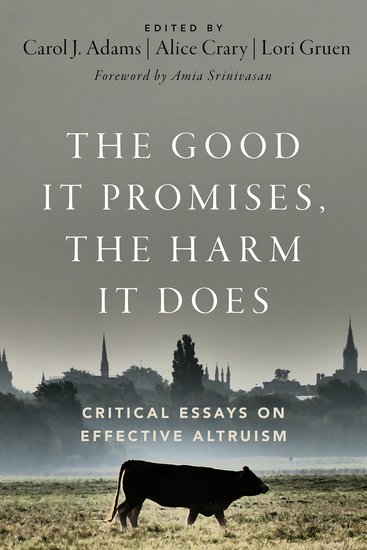
Image: the cover of the book is a landscape with a grayish sky and trees and buildings silhouetted in the background. On the bottom in the center is a cow walking through grass. Across the top the editors are listed, Carol adams, Alice creary, and Lori gruen. Below that and large white letters is the title of the book, the good it promises, the harm it does. Below that in smaller cream colored letters going through the building silhouettes is critical essays on effective altruism.

The Good it Promises, the Harm it Does might seem like a bit of a niche critique from someone who's never heard of the "effective" altruism movement. However, the type of nonsense peddled by EA is linked to greater societal norms and trends- many of which are addressed aptly in this collection. Many of us have utilitarian ethics dancing around somewhere in our belief system and many of us have also likely been harmed or have seen harm from reckless prejudice in said utilitarian outlooks.

EA proponents span a variety of movements, but most of my experience with them comes in the realm of animal rights and environmental movements. Most of the entries in this text also focus on them there. EA proponents range in level of knowledge from newer people who joined up purely because they bought the sales pitch that they will do the most good there, and big name philosophers like Peter Singer (who seems to be at a level of renown where he's unable to see outside of his own perceived genius.) I already had issues with Singer before this, but I found myself even more irritated with him after reading more examples of frankly base level ignorant judgements of his with far reaching negative effects, if only from the reach and notoriety he has.

Effective Altruists essentially claim that they're using reason and analysis to make sure that efforts and donations are funneled into organizations doing the most amount of good. Many people may already have alarm bells going off when they read that, but if you don't, that's ok, keep reading. TGIPTHID is a collection that tackles the issues with their approach from a variety of angles. One of the books biggest strengths is the varying backgrounds that the authors come from ranging from community organizers in densely populated cities to rural farm sanctuary workers and jargony academics. Each entry offers a variety of critiques and as a whole, I struggle to think of how anyone actually absorbing the info could defend EA after reading it.

As one entry mentions, the compartmentalization and numbers game are flawed from the start. Should we stop helping endangered species since there are so few of them left in comparison to larger populations of farmed animals? Do individuals ever matter? What about when that individual touches millions of lives and changes them forever? Others mention the racial make up of EA being almost entirely white, leading to a list of recommendations that reflect what the members see as most effective (which is amplified by their complete lack of understanding of data analysis.) There is an effect of how EA functions similarly to how billionaires choosing what research is important does- they choose what they like, and think is important, causing more marginalized yet important efforts to be buried and exponentially increasing the support for ineffective and/or already dominant efforts. There is also a very patriarchal element in assuming that one can actually do anything based on 100% "reason" devoid of emotion- allowing men's emotional decisions more space since they're automatically seen as more reason oriented and grounded in reality despite evidence to the contrary. One of the most frustrating things about EA that I have known about the longest is their offensively bad understanding of statistics and research. Even if one could argue that their methods and philosophy were defensible (they aren't,) they aren't even calculating things in a way that gives an accurate picture of the numbers. 

All of these problems and more result in EA making recommendations for funding and effort that cause already underfunded movements to get even less funding and the most popular, wealthy, well known movements to get even more. When you're doing shoddy statistical analysis and only looking at variables without proper understanding of various effects, of course the organization with a budget of millions of dollars is "more effective" than the small community organization in a poor area. Even experts in statistics debate about how to best analyze and understand data. EA runs through it all like doing 2nd grade math offers the pure truth.

The entries of this book truly help draw attention to just how dangerous EA is. I do not blame those who are new to it and don't know better. But, the men like Singer white knuckling their way through and sniping at various efforts to try to lend more legitimacy to their self centered view of things us indefensible. Furthermore, what makes Singer so important? Since medical care for individual rescued animals - even when it results in improved medical treatment for others across the board- is a waste of money, wouldn't Singer save more lives if he died and donated each of his organs to someone in need? He could donate all of his income after death to organizations. Actually, wouldn't we be more effective if the Global North all died since we consume the most resources? Singer already argues that disabled people have less worth, will he be ending things when he, like anyone who ages and stays alive, becomes disabled? 

This "rational" way of looking at these calculations in the most shallow levels is a ridiculous way to assess effectiveness. It not only can be used to go the route of fascism like my last example, but it forces people into seeing a tiny sliver of the big picture- similar to assuming that removing a human heart and tossing it onto a table gives one a picture of the function of the entire body's systems working together.

All in all, reading this book would benefit just about anyone. These ideas are all around us all the time. Unfortunately, there is no perfectly effective way to funnel money into a single org that can rid us of the stain these issues leave upon us.

This was also posted to my goodreads.

Sunday, March 5, 2023

Book Review: Imperfect Victims

Image: The cover of the book is a white background with thick black strokes painted messily across the top and center. In hot pink letters is "Imperfect victims: criminalized survivors and the promise of abolition feminism." Across the bottom is the author's name: Leigh Goodmark.
 

Imperfect Victims: Criminalized Survivors and the Promise of Abolition Feminism was honestly an absolutely brutal read. I am very selective about the kinds of heavy trauma and triggering content I expose myself to these days. I don't run from it all, but I don't drown myself in it to the point of exhaustion like I used to (and used to believe I had to.) The reason this book made the cut is that I believe it adds something important to the general discourse around abuse, sexual violence, punishment, and imprisonment outside of the current way these things are often framed.

The book began as Leigh Goodmark's attempted project at working with incarcerated victims to create a book together about their stories. Maryland's Correctional Department squashed the idea and the participants agreed that Goodmark should tell their stories for them. Much of the book is just that- telling the stories of criminalized survivors of violence who either retaliated violently against abusers or were forced to break the law by them. This is what made the book so difficult. You can't really have this discussion without talking about what happened to these women. I actually would have loved to see the book written by them in a more memoir format. But, I also wonder how much the scholarly nature of this book allowed me enough detachment to make it through. 

The reason I say that this adds something important is that I have been around a lot of various processes, legal and not, regarding abuse and sexual violence. There is an urge on the part of those helping survivors to paint them as angels and those who abused them as the opposite, both of them existing in some one dimensional war with one another. This is well intentioned, but fails immediately when the survivor does something human- making a mistake, showing a flaw, or even just doing something strange or non-normative. Goodmark discusses the ways that survivors can both be victims of violence and also have flaws and take actions that may or may not be defensible morally or legally. I am not saying that this has never been done- people have discussed this for as long as I can remember. But, in more mainstream systemic settings like law and academia, many people need this. 

The parts of the book that were slightly easier to make it through was Goodmark's detailing and analysis of prison and criminal (in)justice systems. Again, it is not that no one has ever discussed this, but the combination of topics mixed with these womens own words is an important collection of ideas that makes them more salient and urgent. Goodmark shows just how much the system is stacked against survivors, punishing them for the abuse they suffered, often after the same system ignored their pleas for help. It punishes the victims of trafficking and it punishes women who act in self defense. Issues of race, gender, and sexuality also play very large roles in who is believed and how women are characterized. 

Goodmark makes a strong effort to include information about transgender people in these systems. It was refreshing to see this kind of inclusion in a legal text because these experiences are so often forgotten. I did find her overall analysis of non-cis/het relationships to be lacking. There is one very brief mention of a lesbian woman's horrific experience through abuse by her partner and then the system's criminalization of her. But, I would have liked to see more discussion about same gender (or perceived as such) relationships and how the system will often treat these instances of violence in differently screwed up ways. It also is important in general for those of us in these communities to remember our communities' own capacities for violence- that it is not limited to straight people or hetero partnerships.

The last section of the book offers important criticisms of prison-centered, reformist, non-solutions to these problems, showing how they strengthen rather than disrupt the system. There is also a small discussion of solutions that are based in abolition. This is a good section, but it likely could have been longer. However, thinking of the author's description of the idea for the book, it makes sense that it's more focused on sharing experiences rather than a handbook of solutions (despite the byline which the author may not have chosen.)

There were a couple of things that I would have liked more of her thoughts on. I agree with pretty much everything she discusses. I agree that abuse and violence create situations where victims have to take criminalized action. However, the argument that abuse is a reasoning for an action seems like it could backfire (and already does.) We regularly see abusers turn around and accuse victims and in lgbtq circles or in unexpected power dynamic relationships (a woman abusing a man, a disabled person abusing an abled person, etc,) this can really make those outside the situation struggle to understand it. It also could be said that some abusers abuse because they were also abused. In cis/het partnerships, there is an obvious power dynamic and the abuse often goes in one direction, but not always. In many LGBTQ relationships, gender roles are more complicated. I am not entirely sure what my exact question is. Having seen radical accountability efforts range in everything from very clear cut to extremely confusing, I am curious about where one draws the line in these arguments. I am also curious if Goodmark has opinions on how to stop the abusers. Goodmark obviously is pro-abolition, so what does the other side of the solution look like with violent men (and others?) And, how do we wade through muddier waters where accusations are flying in multiple directions? Again, this is not the thesis of the book, just things I thought of regularly that I would like to pick her brain about.

Overall, Imperfect Victims should be read with care, but also should be given your attention if you're up for it. This is especially true for people who have not survived abuse and/or the prison system and for those who have any role in the legal process. The information in this book is hidden from most people in the USA who get their information from legal and crime dramas or terrible local news segments. I am grateful for all of the women who shared the stories included in this book and I hope that all of them who are still surviving get to live the rest of their lives with as little suffering as can be possible in this awful punitive system.

This was also posted to my goodreads.

Saturday, February 11, 2023

Book Review: It Came from the Closet


Image: the fantastic cover of this book is a illustration of a gravestone with a rainbow behind it and a black sky. In front of the gravestone is a limp wristed pink hand reaching out of the ground. On the gravestone it says it came from the closet in large black letters and queer reflections on horror in smaller letters. Across the bottom and small pink letters it says edited by Joe vallese.

I didn't know exactly what to expect from It Came from the Closet. I often start books that include any sort of academic media review assuming that I may put them down due to boredom. Sometimes media analysis, especially if I haven't seen or read the media, is so incredibly dull to me and just not my thing. This collection is very different than those sorts of texts. There are a couple essays in it that push past the line of pretentious academia enough to be mildly annoying. But, most of these stories couch their analysis in fantastic storytelling of personal experiences of the authors. 

There is a wide diversity of contributors to this book from varying gender and sexuality labels and upbringings. They are well written and the storytelling aspect of it makes this sort of analysis so much more accessible and entertaining to read.

I was basically raised on horror movies and books. It was one of the few things that I connected with my dad on when I got to see him. I recall having a variety of reactions to them from fear to outright laughter. When Army of Darkness came out, having seen the first two Evil Dead movies, we went in ready to laugh and had the whole theater chuckling with us by the end. I also recall The People Under the Stairs with its racist and misogynistic story lines involving child abuse terrifying my 9 year old self to a level that I wouldn't open my eyes until the lights were back on. I saw things that were just fine and others that I believe I was too young for.

I hadn't really thought much about how my queer and transness related to these sorts of media until reading this text. It makes a lot of sense. A lot of the entries sort of grappled with the way monstrosity and terror are used in media and how they can relate to being seen that way themselves. Others discuss how horror allowed them to escape from the real horrors of life, something I can definitely relate to. There's something comforting about watching something that's not real and knowing that it's not. Even in my nightmares, the ones that involve things like zombies and vampires are not nearly as scary as the ones involving social ostracism and abuse. Some discuss how certain tropes and characters were purposely or accidentally coded as queer and many other sorts of analysis.

All in all I think this book really bridges a gap between a queer memoir storytelling and academic media analysis making the topics accessible to a wider audience. But, all of that aside, I truly just enjoyed this book and the voices within. It was a fun read, whatever it is.

This was also posted to my Goodreads.

Thursday, February 2, 2023

Book Review: “You Just Need to Lose Weight”AND 19 OTHER MYTHS ABOUT FAT PEOPLE


Image: the cover of the book is a magenta background with white lettering that is block style with orangeish yellow edges. And large letters it says "you just need to lose weight," and smaller letters it says and 19 other myths about fat people. And small white letters across the bottom it says Aubrey Gordon. Below that and yellow letters it says co-host of maintenance phase.

It's probably best to approach Aubrey Gordon's book, “You Just Need to Lose Weight” and 19 other myths about fat people as a collection of essays or a long form list post. I think this is a good thing for this kind of book. Since there are some myths that some people may already know about and because many readers will likely be fat acceptance activists, this format allows one to skip around. It also means that reading it cover to cover has some repetition of certain citations and points, but I didn't find it to be annoyingly so because the book is not overbearingly long or anything.

A word of caution for fat folks, especially those who experience the highest levels of discrimination, this may be a tough read or unnecessary read for you. As each topic goes on, Gordon starts with some very basic myths and gets into the more niche myths as the book progresses. You may not find much more than a rehashing of your own trauma in the first few, but may see some interesting points in the last few where she talks about things we find specifically in fat acceptance movements.

I'm not 100% clear on terms, but I believe I have experienced much of my life in the straight size to small fat categories. Most of my life I've been in "overweight" or "obese" BMI categories off and on. However even when I was in the "normal" range, I still ran into discrimination from medical providers, including one telling me that an allergic reaction I was having to a medication was due to me having a "high BMI" that made my tongue fat. Yes, really. I also know what it's like being afraid of not being able to get gender affirming care due to random BMI limits that can change office to office. 

Given the amount of medical discrimination I have faced and how harrowing that can be, the compounding of it for very fat folks- especially who have other intersecting oppressions to deal with- is almost unbearable to try to imagine. The urgency of this issue is grand, and yet the social support isn't there. As Gordon covers well in one myth near the end, anti-fat bias is not the "last acceptable form of discrimination" by any means. But, it is something that has unique kinds of hatred thrown at it like any other oppression does and is also compounded by those other oppressions. This book is great for folks who may not fully understand the basics (as well as some next tier info as well.)

I listened to the audiobook read by Gordon and really enjoyed it. Her voice is that of a passionate but familiar (imaginary) friend from her podcasts. I also just wanted to give her a hug afterwards. Putting together an accessible listicle style book with your own trauma and keeping it readable and not overwhelming is no easy task. This book brings up many emotions but isn't trauma porn. 

I definitely recommend this (as well as maintenance phase podcast) to anyone needing to learn more. I recommend at least the last third to folks who already know a bit.

This was also posted to my goodreads.


Tuesday, January 3, 2023

Book Review: Street Rebellio


Image: the cover of the book is a orange background that is a tinted version of a black and white photo of protesters in the street. There is smoke in the air and several figures in various positions our advancing toward a chaotic area of the street. In the center is a white square. And white letters at the top of the square is the author's name Benjamin s case. Below that street rebellion and larger White letters. Below that and smaller white letters is resistance beyond violence and nonviolence.

I did not realize going into Ben Case's Street Rebellion: Resistance Beyond Violence and Nonviolence that I only had one degree of separation from the author. I'm so out of touch with local Pittsburgh organizing these days that I did not know the author personally, but I'm proud that they're from here. This book was one of the more exciting and motivating reads on the topic of movements and tactics. I had all kinds of nostalgia during the experience that made me both miss and NOT miss my rowdy days.

Case tackles many of the sources held up as "evidence" of the success of "purely non-violent" activism in detail. This book does something different than some others in this vein though. Rather than arguing that another form of action is the TRUE way or path to success, he argues that everything from pacifist action to riot is an inevitable consequence of oppression and the fights that exist to combat it. Rather than simply staying "Riots work," Case takes a more nuanced and realistic approach seeking to better understand and inform discussions about movement structure and results.

I honestly never knew the roots of many peoples idea that "non-violent" organizing is the most successful. I keep putting "nonviolence" in quotes because Case makes it clear throughout the book that this is a very poorly defined category, especially by self-professed non-violent organizers and trainers. It turns out many of the sources that people claim are comparing violence and nonviolence are actually comparing revolutionary war efforts including massive human casualty and all other movements. It's more complicated than that but for the sake of a shorter review that's what I'll say. Through the telephone game of life, this data was warped to serve an agenda that states that the only really successful way to challenge oppression is with forms of protest that do not involve any sort of self-defense, property destruction, forms of rioting, and so on. What is possibly the only part of the book that isn't super exciting is a chapter where case does a small analysis of the data around various movement tactics. It's pretty much written like a scholarly article and anyone without a research background is going to struggle with it. But it's necessary because it does something that these other groups claim to have done and shows that there is little basis for what they are saying. Pairing this with his overall analysis was a smart move in my opinion even if it goes over some people's heads because it will prevent detractors from claiming that they have done research and that Case has not.

Pretty much anyone in any form of organizing has met self-professed non-violent activists and/or the peace police. It is widely accepted in many circles that nonviolence, whatever that means, is the most effective means of seeking change. Anyone that diverges from this can be accused of everything from being a fed, being an in outside agitator, co-opting the movement just to have fun breaking things, or just being ignorant of the true nature of justice. Ben Case shows in a myriad of ways that this is not only untrue, but it feeds into the narrative of the state and other authoritarian structures that seek to profit/gain authority from appearing to be allied with resistance to oppression while also being agents of that oppression in very direct ways.

It seems fitting that a Pittsburgher wrote this. I think of very specific examples such as a brief argument I witnessed during the G20 as a black bloc rolled a dumpster into the street. Two women dressed and what looked like a Halloween costume of 60s hippies with flowers painted in their faces started screaming at the A-team, "Non-violent! Nonviolent!" One of the anarchists turned to them and yelled back, "Property destruction isn't violence!" It's an interesting exchange that this book made me think about because it shows a glimpse into how ill fitting this sort of exchange was for a moment when heavily armored police and deputized reactionaries were shooting weapons into the crowd. What those women likely didn't know was that many tactical discussions were had about what kind of things would work in different scenarios. As a result a ton of different kinds of actions from many different groups were planned during the G20. I recall the Pittsburgh principles where many active groups basically agreed not to talk shit on each other's tactics during the movements of that time.  

Case also mentioned how former mayor Peduto used the 'outside agitator' myth to make himself appear as if he was allied with anti-racist movements during George Floyd uprisings while simultaneously labeling any action he didn't like as that of a lone invader. He also attempted to lie about police brutality and weaponry to the faces of the victims of it as well as the media. The book doesn't mention (because it's not just about Pittsburgh) that Peduto has a pre-Mayoral history of coming after anarchists, often as a whole, anytime any action was taken that he didn't like. Peduto encourages a parade he can join, not an action that challenges his position or that of his police (who are notoriously corrupt- even for cops- in Pittsburgh, but that's a whole other rant.)

Case also includes interesting conversations that he had with various activists and organized from various generations about their experiences being part of riots. I found this interesting because I see it so little in books about tactics. In these conversations, they talked about how and why people were involved in these things and what function they played. Rather than going through a step-by-step guide of why XYZ tactic is going to work in XYZ situation, there is a much more human aspect to these conversations. And in the end, spontaneous action and even highly pre-organized action is all very very human.

Most of the book takes a confident but gentle approach, walking The reader through each step of cases analysis. When we get to the last section, we really get to feel that passion that the author has for the subject. I think it was smart to leave this to the end carrying the reader along so that they can truly grasp why that passion exists. So, next time you run into somebody who is a non-violent activism trainer or who is telling you that they know for sure that one tactic or a few are the only ones that ever work, hand them this book. I hope more people reading this will lead to better conversations across movement lines about what tactics can work in various situations rather than some sort of argument about what tactics can work at all. I also hope that this book reaches greater audiences to help dispel the extremely successful liberal propaganda about good and bad protesters detailed well in the book.

This was also posted to my goodreads.

Tuesday, December 6, 2022

Book Review: Try Anarchism for Life


Image: the cover of the book is a green background with a hot pink circle a in the center. Inside the symbol or green illustrations of leaves winding through the lines. On top of the symbol and lighter green cursive lettering is try anarchism for life. Around the top edge of the symbol and small black letters is Cindy Barukh Milstein. Along the bottom edge of the circle is the beauty of our circle.

Try Anarchism for Life is a break from Cindy Barukh Milstein's usual style, (which I like very much for the record.) It is more abstract in some ways, more playful, and more accessible, (though I do find their other books quite accessible as well.)

The book, published by Strangers in a Tangled Wilderness, is a lovely printed collection of artworks sent to the author paired with Milstein's short writings on various topics. There are lino and wood cut prints, illustrations, graphic design, and more. I really loved the images that they chose to include in this book and Strangers did a great job with the design and printing.

When I say this book is accessible, what I mean is that I think it could be handed to almost anyone, including youth within reason as well as older folks. It has a playful and simplistic way of talking about who anarchists really are and creating a much larger picture than the black bloc that some people may see on the news (which Milstein and I both also support for the record.) Many people do not connect the mutual aid efforts that they run into with anarchism due in part because in those situations, anarchists don't often call them anarchist events- they're more focused on getting the work done than branding. People often associate anarchists with what they're against. Given that the vast majority of anarchism is based on cooperation and taking care of one another, this sort of quick run through of various elements is very important.

There is the curmudgeon and me, who no longer organizes due mostly to health problems, but also for other reasons. I've seen some stuff go down that I and other anarchists should not be proud of. This part of me feels the need to remind the curious reader that anarchists, like all human beings, can have some really messy group dynamics and anti-aurhoritarian groups can attract people looking to exploit that. This book doesn't talk about that, nor am I saying it should. I'm saying that this book creates a beautiful picture of anarchy and I wish I could say that we could match that perfectly in real life all of the time. 

That said, one of the best messages of the book is that one can do anarchism day to day alone or with some friends in a variety of ways, regardless of if one joins an anarchist labeled group. Anarchistic things are happening all around us and many people don't even realize it. When a conflict arises or when something doesn't work, we can change and grow in new ways. Anarchism can only stay alive with said growth.

This book does an excellent job of showing that anarchism is not what reactionaries believe- either a structureless society full of harm, an authoritarian communist dictatorship (addressed directly in the book, by the way,) or a chaotic street party based purely on destruction. It is a consistent movement on a long journey with no end. It is a constant struggle to create better things in the place of the harmful structures that exist to take it all away. 

I believe that Milstein conveys these and more things in a way that is light and playful. The reader does not have to prepare themselves for a 800 page book full of dead anarchist theory one needs a background in or college degree to grasp. They can read this and know what anarchism actually looks like on a day to day basis, and get to enjoy some excellent artwork in the process.

This was also posted to my Goodreads.

Book Review: Summertime - reflections on a vanishing future


Image: the cover of the book shows an expansive charred landscape from the perspective of a kookaburra who perches on a damaged tree on the right side of the cover. The skies are orange red from fires. Across the top is the author's name in white letters. Below that is summertime and black letters. Below that is a black line and under that in smaller black letters is reflections on a vanishing future.

I have to be careful with what I read and watch these days. For a variety of reasons, including clinical ones, I simply do not read or watch graphic descriptions of trauma for the most part. There are exceptions where I will because it is wholly necessary for a specific situation, but long gone are the days where I will watch undercover videos from animal farms as they reach the media. As a result, I was a little worried about going into Summertime: Reflections on a Vanishing Future. The last time I read about wildfires and how they affected humans and other animals in the area, it was a story of people abandoning farmed animals in enclosures to burn to death. Their experiences (and the coverage ignoring why they were trapped and what their fate would have been otherwise) dominated my obsessive thoughts to the extent that I could barely function. 

I did not have that experience this time. I was truly impressed by Danielle Celemajer's ability to navigate the most horrific of topics in a way that both allows the reader to attend to their seriousness and sadness while also not beating them over the head with some sort of trauma porn. She allowed the reader to see the bigger picture of her life with her family and friends- including Jimmy and Katie.

At one point in the book, the author discusses how impossible it would be for a human being to attend to the life of every animal lost in Australia's wildfires. It would involve multiple lifetimes of doing nothing but thinking about the suffering of animals at all times. The truly unimaginable number can cause us to detach from things. That is part the importance of books like this that allow us to understand the lives of individuals. The author does not allow the reader to run from the situation or to intellectualize the problem. She holds your hand and walks you through it with her in such a way that you do not need to think about what you believe. Reading this book embedded this experience within me and gave me what I assume is the best understanding someone could achieve who wasn't there.

I'm intentionally being somewhat vague in describing the specific characters of this story because the author does this as well in the beginning. 

I am frustrated that this book is not being marketed in the USA. I originally thought that people in the USA would not be able to read it, but I just checked and there are some websites selling the ebook internationally I believe. I think this book is of critical importance for us to understand what is happening to this planet and how it affects not just humans but everyone else we share it with. With wildfires raging all over the globe, many of us do not really understand what a wildfire is like. I for instance, did not know that they can envelop a home in moments, traveling so quickly that by the time you see them on the horizon you may be doomed. As this planet burns, as ice caps melt, as indigenous peoples island homelands sink, as countless species disappear forever, and countless more die in nets and in slaughterhouses, it can be difficult even for those intimately connected not to detached from it all. Celemajer manages to tell such difficult stories in ways that allow us to absorb them without denial and without shutting down.

 I am a different person after reading this book. I can only hope that others will have similar experiences, if not from this book, from the stories of others. I hope others will be able to understand the lives of the humans and other animals and this story and apply that understanding to the trillions who lose their lives every year so that we may understand what we're responsible for and what needs to change. It's so much bigger than most conversations being had. I leave this review knowing it's insufficient for this topic.

This was also posted to my Goodreads.